





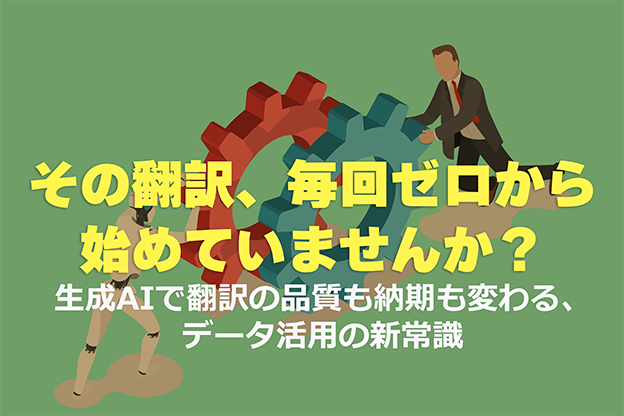
Are you starting from scratch every time you translate? The new common sense of data utilization: how generative AI changes both translation quality and delivery times.
"How did I translate this technical term last time?"
When working on translations, you may encounter situations like this.
Searching through past documents, checking glossaries, and comparing them with previous translations. Once you finally find it, you then have to consider whether it fits the current context.
Are you repeating the same tasks every time you translate?
In fact, past translation data is packed with hints to streamline translation work and shorten delivery times.
In this article, we will introduce the utilization of translation data dormant within companies and the "Asset Accumulation AI Translation" proposed by Kodensha.
1. Corporate-specific language revealed through the translation of integrated reports
For example, let's imagine a scenario where you are translating IR materials for a listed company from Japanese to English.<
Integrated reports not only contain a variety of corporate information such as management policies, business strategies, research and development, and environmental initiatives, but also feature numerous technical terms specific to each industry, unique product names, and expressions related to R&D.
Furthermore, there are unique phrasings used when explaining the values the company cherishes and its business strategies.
When translating these expressions into English, simply translating the meaning of the words is not enough.
What English expressions have been used in past reports and on the website? Is the company conveying a unified message? These points are also important.
Moreover, integrated reports are often published annually, building on the content from previous years while adding new information.
This is where past translation data comes into play.
Because these materials are translated every year, there is value in leveraging past translations for future ones.
2. Translation data is too valuable to leave dormant
Companies possess a large number of documents that have been translated to date.
- Integrated reports and annual reports
- Websites and company brochures
- Product catalogs and technical documents
- Instruction manuals and guides
- Press releases
These materials contain a wealth of company-specific terminology and expressions.
However, once translation is complete, the data is often stored as Word, Excel, or PDF files and may not be fully utilized in subsequent translations.
Finding them when needed can also be a struggle. In some cases, source and translated texts are managed separately, or only the person in charge knows where they are saved.
Since you have invested time and money into these translations, doesn't it seem a waste if they cannot be leveraged for future work?
This is where the concept of "translation assets" comes into play.
Translation assets here refer to resources that can be used for future translations, such as past translations and glossaries.
Instead of storing translation data merely as past deliverables, accumulating it in a way that helps with future translations is what utilizing translation assets is all about.
3. AIUtilizing "Company Language" in Translation
This is where "Asset-Accumulating AI Translation" comes in.
General AI translation generates translations based on the input text.
"Asset-Accumulating AI Translation" aims to reflect company-specific terminology and expressions in translations by having the generative AI reference past translation data and glossaries.
For example, suppose a company has used specific English expressions for certain technical names or business concepts for many years.
By utilizing past translation data, it becomes easier to maintain consistency in terminology and phrasing while referring to conventional expressions in current translations.
Furthermore, by referencing past translations and efficiently translating recurring expressions, it is possible to reduce the time required for translation.
As a result, "Asset-Accumulating AI Translation" can be expected to offer the following benefits.
- Terminology consistency: Reflecting company-specific expressions such as product names and technical terms.
- Streamlining translation tasks: Reducing redundant translation work by utilizing recurring expressions.
- Shorter turnaround times: Reducing the time required for terminology verification and translation work by leveraging past translation data.
- Knowledge retention: Making it easier to carry over past translation expressions even when personnel change.
4. Assets grow with every translation
Let's imagine the near future.
Suppose there is a company that translates its integrated report every year.
In the first year, you start by organizing past translation data and checking terminology and expressions.
In the second year, you utilize the previous year's translation data while adding new business information and technical terms.
By the third year, you leverage the further accumulated data to proceed with translation while ensuring consistency with previous expressions.
If you can utilize past translation data, you can reduce the effort of looking up the same terms or checking past expressions from scratch every time.
This allows translators to spend more time understanding new information and considering more appropriate expressions.
Streamlining translation work does not just reduce working time. It also leads to creating the leeway needed to improve quality within a limited timeframe.
This is not limited to integrated reports.
The same applies to tasks where translation occurs continuously, such as product catalogs, websites, technical documents, and manuals.
With every translation, the next one becomes faster and smoother.
We realize such a system through AI and translation assets.
5. It's okay if your large volume of translation data is not organized
"I have a huge amount of past translation data, but it seems like a daunting task just to organize it..."
Some of you may think so.
In reality, even if you have a large amount of translation data, it is not always stored in a database. It may be saved in various formats such as Word, Excel, or PDF.
However, you do not need to have perfectly organized data from the start.
You can begin by grasping what kind of translation data exists and organizing what can be utilized for future translations.
At Kodensha, you can also consult with us about organizing and utilizing such translation data.
"I want to utilize the translation data I have accumulated over many years"
"I have a glossary, but I don't know how to reflect it in AI translation"
"I want to shorten translation lead times while also achieving consistency in expression"
If you have such challenges, please feel free to consult with us.
6. It is not just the latest AI that creates the future of translation
With the evolution of AI, the use of AI translation and post-editing is spreading in the translation industry, changing how translation is performed and the role of humans.
However, no matter how much AI evolves, the specialized terminology, expressions, and unique knowledge cultivated over many years that differ from company to company are valuable assets held by each organization.
Some of those assets may be lying dormant in past translation data.
Simply introducing the latest AI technology is not the only way to evolve translation operations.
It is about reviewing the data accumulated so far, organizing it into a usable format, and connecting it to future translations.
Instead of just leaving translation to AI,let AI utilize your company's translation assets.
Kodensha's "Asset-Accumulating AI Translation" proposes a new way of handling translation work that aims to shorten lead times and improve operational efficiency while maintaining translation quality and consistency.
Turning your past translations into your future translations.
Why not give new value to your dormant translation data?
 Hatena Bookmark