





Are you learning a foreign language? And what is the reason you are learning that foreign language?
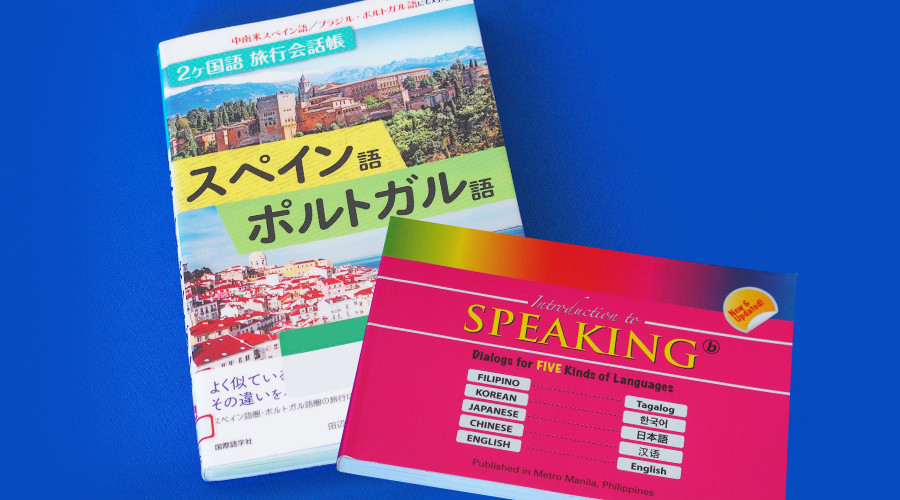
"Since we develop Chinese input and translation software, I felt I had to understand Chinese."
With that thought in mind, I started learning Chinese just before I turned 40. Beyond that, I feel like I have lived a life inseparable from language acquisition, including English, which I started learning in junior high school, Spanish, which I dabbled in as a second foreign language in college, and Korean, which was necessary while I was stationed abroad for work.
While the terms "language" and "linguistics" can sound a bit stiff, using a more familiar expression, it is about "words," and as long as they are "words," I ultimately aim to be able to speak them. I feel that being able to speak the language of the other party is often advantageous and adds to the enjoyment, whether it is in business, such as phone calls with overseas clients, or in private life, such as face-to-face communication with local people when traveling.
When going abroad for business or pleasure, it is quite useful to bring a book about the country's language—even a simple collection of conversation examples will do. Just saying a single greeting phrase written in the local language can sometimes bring great joy.
To give an example of "Good morning," if I greeted people in Bali with the Indonesian "Selamat pagi," they would happily reply "Pagi, pagi!" and if I said "Günaydın" in Turkey, they would give me a thumbs up and say something back.
The fact that I can get such a positive reaction from just a greeting must be because I am a foreigner who is not fluent in their language, and that may have been a small surprise for the local people, serving as a trigger for them to start their day in a good mood.
At the same time, it seems there is a kind of privilege that allows for incorrect expressions unique to foreigners.
For example, right after boarding a flight from Madrid, Spain, to the port city of Porto in Portugal, a flight attendant asked me for my seat number.
Flight attendant: What is your seat number?
Me: (trying to say 14) dez quatro
Flight attendant: Catorze~!
To put this in English terms, it would be like saying "Ten Four" instead of "Fourteen," so the flight attendant found it quite amusing.
On this trip, I kept a palm-sized book in my bag with Spanish conversation examples on the left page and corresponding Portuguese ones on the right. While referring to it on the bus from Porto Airport as I transferred to a train to head to my hotel, I asked a passenger, "How do I get to the XX Hotel?" and several people answered at once. Even when I got off at the nearest stop and was walking, they pointed toward the hotel from inside the bus.
If you try to speak the local language with your own mouth, even if you are looking at a book, it creates an interaction with the people who live there, and I think it makes for a much more profound trip than just being led around to tourist attractions by a guide.
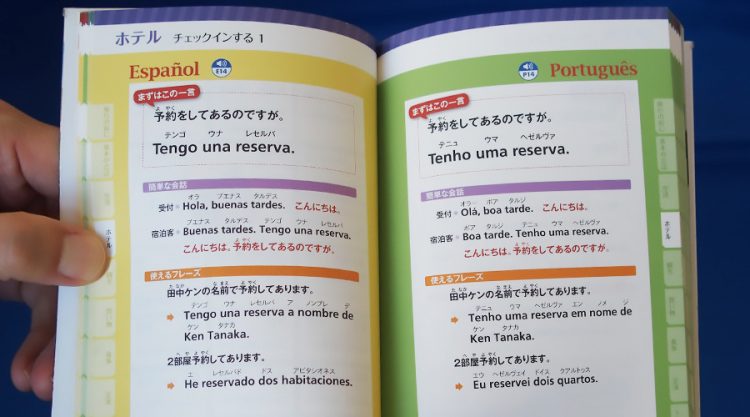
A phrasebook I kept tucked in my bag during my travels
Aside from cases where one unintentionally misuses a foreign language, let me introduce an example where the intent was purely to get a laugh.
Looking at the Tagalog section of a five-language conversation guide I bought at a bookstore in Cebu, it seemed that consonants and vowels often alternate, giving the impression at first glance that it wasn't all that difficult. However, when I actually tried to pronounce it, I had absolutely no idea what to do with the accents or intonation. Even so, with the conversation guide in one hand, I would speak to the airline counter staff as if I were a native speaker, saying things like "Do you speak Tagalog?" or "I'd like an aisle seat, please," which cracked the staff up. Even the staff at the next counter joined in, and they all seemed to be having a genuinely good time.
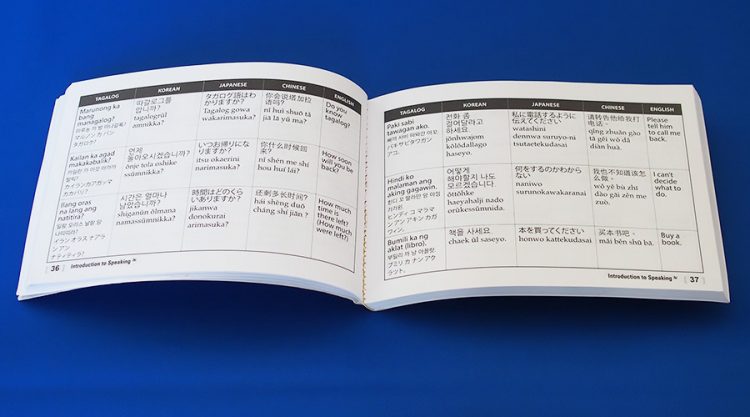
A five-language conversation guide I bought at a bookstore in Cebu
It is an undeniable fact that various economic disparities and gaps between rich and poor exist all over the world. However, I have heard that while some countries are tolerant of travelers who cannot speak their language and show an open attitude toward those who try to speak it, others treat travelers who cannot speak their language coldly. Which country can truly be called wealthy?
There are some people who, because they can speak English, try to get by using only English regardless of the language of the country they are visiting. But in my opinion, there is nothing more wasteful than that. The moments when I can interact with the local people are the greatest thrill of traveling abroad for me, and they satisfy my heart far more than capturing scenic spots with a camera. And based on my experience, I firmly believe that "language" is the best medium for that.
There is no end to mastering a foreign language, and that is exactly why I continue to learn foreign languages as "language."
 Hatena Bookmark