




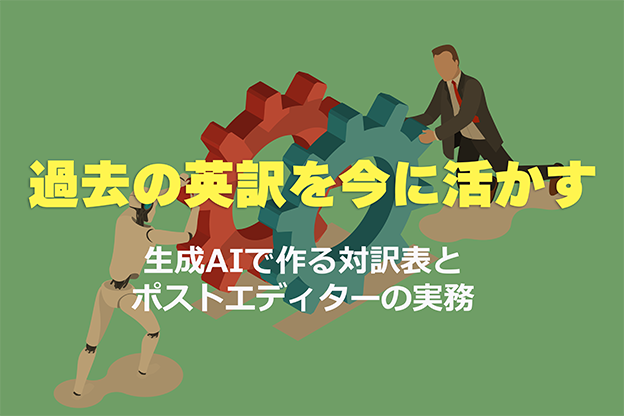
Translating integrated reports by leveraging the previous year's English translation. Practical work for bilingual tables created with generative AI and post-editors
If you open the previous year's integrated report, you can see how business names and technical terms were translated into English.
For reports published annually, you naturally want to leverage the expressions used in the past for this year's translation.
So, if you have the Japanese and English PDFs on hand, can generative AI immediately reference past translations?
At Kodensha, for the English translation of a company's integrated report, we organized the previous year's version provided by the client and utilized it for translation using generative AI and human proofreading.
The part of the work that took the most time was the process before correcting this year's English text.
Although the Excel file created by the AI had Japanese and English side-by-side, when compared against the original PDF, we found English text that started in the middle of sentences or sentences where separate parts had been combined into one.
How did we organize the previous year's bilingual text before checking this year's translation?
We will trace the actual work performed by the post-editor.
1. Create a bilingual table of Japanese and English from the previous year's PDF
First, a translation coordinator used the previous year's integrated report PDF to map the Japanese and English using generative AI.
In translation practice, this task is called "alignment."
By matching the original text with the translated text in units such as sentences or headings, it becomes easier to find past English translations when similar sections appear in this year's original text.
However, integrated reports contain a mix of multi-column body text, headings, bullet points, and charts.
Humans can look at the page and determine the order, such as reading the left column before moving to the right column.
In this instance, there were places in the Excel file output by the AI where the order of the Japanese did not match the column or page order of the original PDF.
Even if the Japanese and English were on the same line, there were cases where sentences from different sections were combined, and sometimes the correct pairing could not be found just by looking at the preceding and following lines.
The post-editor then checked the notes the AI added to the Excel file and compared them with the original source material.
They corrected any misalignments and deleted unnecessary parts.
In places where sentence or item breaks were broken, they referred back to the original manuscript to determine where the breaks should be and adjusted the order accordingly.
2. Find the original sentence start from English sentences beginning with lowercase letters
The work logs contain clues that helped the post-editor identify the misalignments.
One such clue was that the English words at the beginning of the cells started with lowercase letters.
If a cell was supposed to contain an independent sentence, it is possible that it was cut out from the middle of a sentence.
The post-editor traced back to the original material to find where the actual beginning was.
Places where long sentences did not end with a period or full stop also served as triggers for verification.
Sometimes the continuation had moved to another line, or sentences that should not have been connected were joined together.
Even when trying to return them to the correct position, there were cases where the corresponding sentence could not be found in nearby lines, or the corresponding original text could not be found in the bilingual table.
In such cases, simply moving rows in Excel is not enough to solve the problem.
It is necessary to go back to the original page layout to verify the order and breaks of the text.
The bilingual table data created at this time consisted of 2,476 rows.
Candidates for manual verification included rows suspected of having long sentences ending in the middle, and rows where the Japanese column was empty while the English column had content.
The latter often involved text within charts or images, and checking the page layout was necessary to confirm the reason for the empty cells.
This is the difference between a table that looks organized and a translation that is correctly aligned.
3. Indicate the parts organized by humans and review the instructions for the AI
The post-editor reported to the coordinator during the process that they were spending time correcting misalignments in the bilingual text and sentence breaks.
The coordinator provided the generative AI with examples of the sections already organized by humans and gave new instructions to review the remaining alignments based on the reported issues.
After that, the final finishing was performed using the re-aligned Excel file.
What led to the next step here was not just the report that it was "not matching," but also specifically conveying how it was misaligned.
- The correct counterpart cannot be found in the preceding or following lines.
- Separate items are connected.
- The order of columns or pages in the PDF is disrupted.
By presenting these issues along with the organized examples, it was possible to reflect them in the re-processing instructions.
In the task of organizing translation assets, a division of labor can be established where the AI creates a draft of the bilingual table, and humans verify its contents against the source material.
In translation utilizing generative AI, it is important to plan the schedule for the entire translation process by considering not only the time required for generating translations but also the time needed for organizing and proofreading past translation assets.
4. For this year's English translation, compare past translations with the client's specifications
After organizing the bilingual text, the post-editor utilized past translations where applicable in this year's English translation check, and corrected parts that did not conform to the client's specified translations or rules.
They also adjusted the translation style while communicating with other workers.
When multiple people share the work, whether to use an expression chosen in one section in another section is a point that should be confirmed among the personnel in charge.
For example, even if it refers to the same project as the previous year, if this year's specified translation has been updated, it is adjusted to this year's notation.
Even if the same measure is being explained, parts where the target or progress has changed are translated according to this year's source text.
Having past translations allows for examining which terms to carry over and which information to align with this year's content, after confirming the conventional expressions.
In the process of checking the previous year's bilingual text, we confirmed whether "this Japanese and English refer to the same part."
In the process of proofreading this year's English translation, we determined whether "this past translation matches this year's source text and the client's specifications."
Both involve looking at past materials, but the former organizes the bilingual text that can be referenced, while the latter determines whether that translation can be adopted.
5. Start with the materials you want to use for the next translation
Documents updated annually, such as integrated reports, contain business names, technical terms, and explanations that will be referenced repeatedly in the future.
If you have the previous year's Japanese and translated PDF on hand, you can start by selecting the chapters and terms you want to carry over to the next translation.
By organizing the correspondence between the source and translated text and comparing it with this year's specified translations, it becomes clear which materials should be kept to make it easier for the next person in charge to use.
Kodensha's "Asset Accumulation AI Translation" utilizes past translations and glossaries with generative AI, combined with human proofreading, to produce English translations that suit your documents.
"I have the previous year's English version, but I'm still looking up terms one by one this time," or "Past translations and current specified translations are mixed together."
If you have such materials, please let us know your concerns.
We will work with you to consider where to start organizing and in which translation process they can be utilized.
Related Services
Asset Accumulation AI Translation | Kodensha
 Hatena Bookmark